


Expert tip: AI-powered automation eliminates manual tasks, reduces sources of error, and optimizes processes so that financial closings can be completed in a few days instead of weeks—more accurately, faster, and with more time for analysis.
It's time for the monthly closing. But this time it's different, because AI-powered automation has already eliminated the most common sources of error, turning the closing process into a piece of cake for your team.
Learn more about Schulmeister's recruiting expertise in finance:
What is AI closing process automation?

At its core, AI-powered financial close automation involves using intelligent software to automate the repetitive, rule-based tasks that take up most of the team's time during the close cycle. Instead of a human manually checking off numbers and transferring them between systems, a software “robot” or intelligent platform does this automatically. This shift is in line with the “Finance 3.0” concept, where the goal is to create a seamless flow of data that requires minimal human intervention for routine processes.
This technology can generally be divided into two main categories:
1. Robotic Process Automation (RPA): Think of RPA as a digital assistant that can mimic human actions. You can teach it to log into the ERP, download a report, copy the data, and paste it into a reconciliation file. This solution is ideal for bridging the gap between older systems that do not communicate with each other.
2. Integrated close management platforms: These are more advanced, specialized software solutions that centralize the entire close process. They connect directly to financial systems and use AI to automatically perform reconciliations, manage checklists, and provide a real-time overview of the entire close status.
The main advantage is that both approaches free powerful controllers from tedious manual work and allow them to focus on what they do best: analyzing the numbers, understanding performance, and providing strategic advice.
Identifying bottlenecks in the month-end closing process
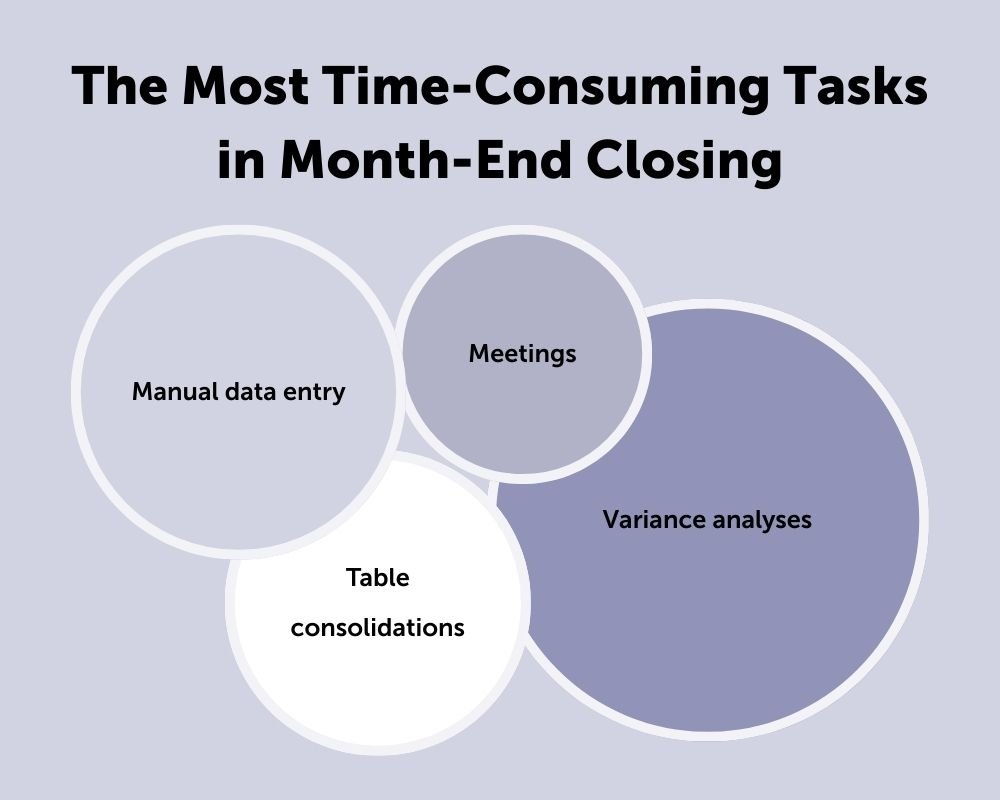
Before the problem can be fixed, it must be identified. For most finance teams, the biggest time wasters during month-end close are predictable and universal. A good first step is to sit down as a team and map out the entire process to determine how many hours are spent on each of these common bottlenecks:
- Manual data entry and journal postings: Manually entering data from various sources into the general ledger. This is not only slow, but also a major source of errors.
- Bank and intercompany reconciliations: Manually matching thousands of transactions between bank statements, credit card statements, and internal company accounts.
- Spreadsheet-based consolidations: The risky and error-prone process of linking multiple spreadsheets from different departments or companies to create a consolidated view. A single incorrect formula can throw everything off.
- Data collection for variance analysis: The time-consuming task of pulling data from multiple reports to investigate why actual values differ from the budget or forecast.
Once the top 2-3 bottlenecks have been identified, there is a clear target for where automation will deliver the biggest and fastest return on investment.
Which tools can automate the month-end closing process?
Once you have identified your bottlenecks, you can now select the right type of tool. You don't need to implement a huge new ERP system to get started; the key is for your team to choose a technology that solves a specific problem.
- If the problem is bridging legacy systems: An RPA solution is often the best place to start. It is a non-invasive way to automate data extraction and entry without requiring changes to the underlying accounting software. This is an important first step toward automation.
- If the problem is a high number of reconciliations: A dedicated automated reconciliation platform is ideal. These tools use artificial intelligence to automatically match millions of transactions at high speed and flag only those exceptions that require human review.
- If the problem is a lack of transparency and control, an integrated close management platform is the most comprehensive solution. It provides a central command center for the entire close, with automated task lists, status tracking, and a complete audit trail.
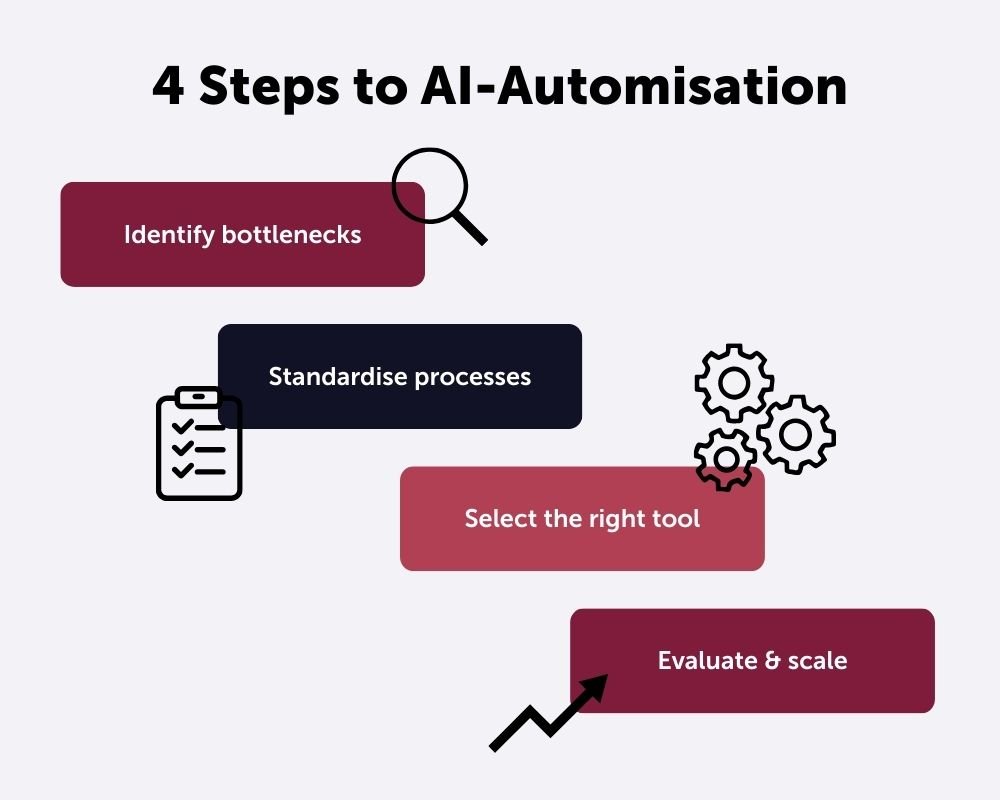
How to implement AI closing process automation in 4 steps
Getting started with artificial intelligence doesn't have to be a multi-million dollar, two-year project. With a focused, step-by-step plan, you can deliver real value within a single quarter.
- Start small (pilot project): Select one of the bottlenecks you have identified, such as reconciling a single high-volume bank account. Don't try to boil the ocean. Choose a process where you can prove the concept and demonstrate quick wins.
- Document and standardize the process: Before you can automate a process, it must be standardized. Work with your team to document the exact steps, rules, and decision points for the selected pilot process. This is often a valuable exercise in itself, as it can reveal hidden inefficiencies.
- Work with a vendor and your IT team: Work with your IT department to ensure that any new tool meets security and integration standards. Then talk to the software vendors. Ask for a demonstration using your own sample data so you can see exactly how your problem can be solved.
- Measure, learn, and expand: After implementing your pilot project, measure its success compared to your baseline. How many hours were saved? Was the data more accurate? Use this success story to build a business case for automating the next bottleneck on your list.
Which month-end close tasks can AI automate?
- Account and bank reconciliations
- Transaction matching
- Data validation
- Recurring journal preparation
- Intercompany reconciliations
- Variance and anomaly detection
- Close task tracking
- Management reporting preparation
What skills does the finance team need to manage automated closing?
As automation takes over manual tasks, the skills that make a good accountant are beginning to change. The role of finance professionals is evolving and demanding new skills:
- Process improvement mindset: Your team needs to think like a consultant and constantly look for ways to improve and streamline the new, automated workflows.
- Data analysis and visualization: With more time available, accountants need to become proficient in tools such as Power BI or Tableau to analyze data and present their findings in a clear, compelling manner.
- System and technical expertise: Financial experts are not programmers, but today they need to be able to learn and manage new software platforms.
- Collaborative partnership: Ultimately, your finance team should become proactive advisors to the business, leveraging insights from faster close to drive strategic decisions.
When you invest in these skills, you're not just buying software, you're building a finance function that's ready for the future.

FAQ - Frequently asked questions
AI-powered intelligent finance operations (IFO) can help deliver demonstrable results in financial planning and analysis, procure-to-pay, order-to-cash, and record-to-reporting.
Not anymore. While the first systems were expensive, the advent of cloud-based software (SaaS) has made powerful automation tools accessible and affordable for medium-sized companies.
In most cases, no. Modern automation tools are designed to be layered on top of and integrated with your existing systems. RPA, in particular, is designed to work with any application, no matter how old it is.
There is evidence that AI will complement rather than replace skilled accountants. It automates the tedious and repetitive parts of the job, allowing professionals to focus on higher-value analytical and strategic tasks that require human judgment. It changes the work, but it doesn't eliminate it.