


![[Translate to English:]](/fileadmin/_processed_/b/0/csm_schulmeister-blogartikel-cfo-aktuell-header_bdc8deccf5.png "[Translate to English:]")
Preliminary remarks: Survey Methodology
The representative study at one glance:
- 824 participants
- Finance / Controlling sector
- Austria
With a total of 824 persons from finance and accounting, controlling and related functions of Austrian companies participating in the survey and a response rate of around 8%, the survey can be considered to be representative. Furthermore, the good response rate is an indicator of the high relevance of the survey topic among the target group. The respondents are 34% female and 66% male. Those over 40 are clearly more strongly represented than those under 40. While the share of over 40-year-olds is 61%, only about 8% of the responses come from the group of under 30-year-olds. This probably also reflects the actual age distribution in the population of functions surveyed. The databases of Schulmeister Management Consulting and the Controller Institute were used as the data basis for the target sample.
This paper presents the results of the survey on the following topics:
- Satisfaction with work culture, new work factors and drivers of a new work culture,
- personal work situation, workload and working conditions, and
- new talent and labour shortages.
Work Culture in Finance: High Satisfaction Despite Major Change
Despite significant changes in the working environment during the pandemic years, satisfaction among finance professionals remains high.
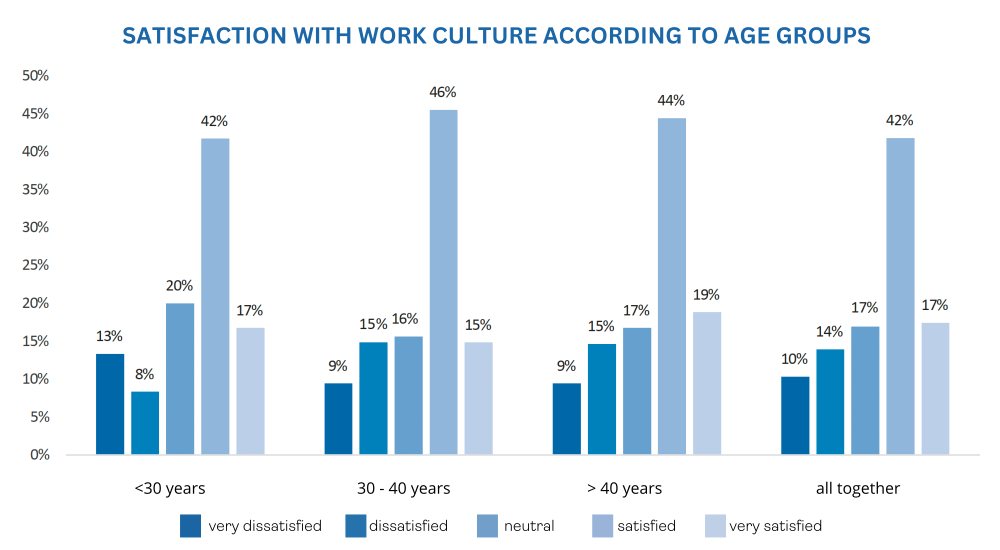
- 59% of respondents report being satisfied with their work culture
- 24% are dissatisfied
- 17% are neutral
Interestingly, satisfaction levels are similar across all age groups, suggesting that both younger and more experienced professionals perceive the working environment in a comparable way.
Several indicators show that many companies are already moving toward modern finance work environments:
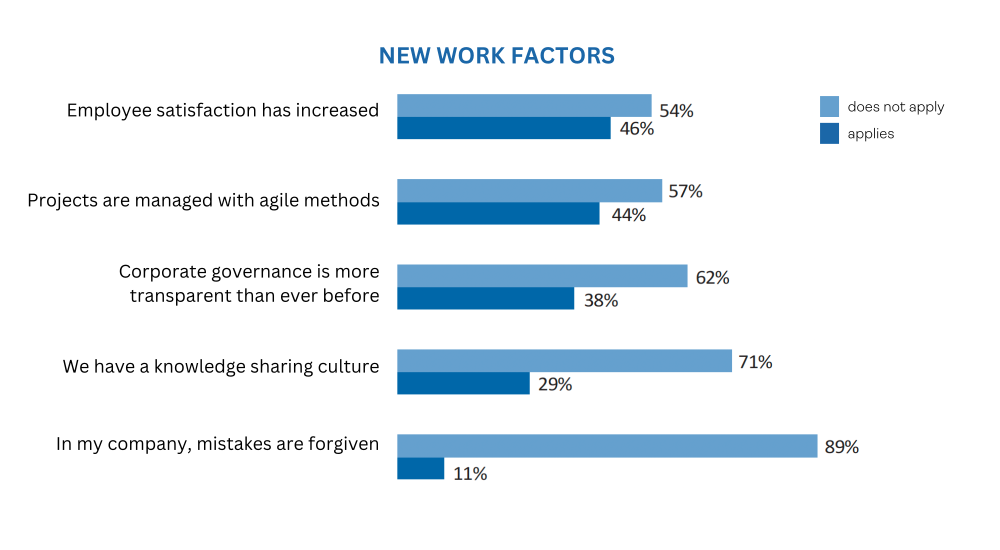
- 89% say mistakes are tolerated
- 71% report a strong knowledge-sharing culture
- 62% experience more transparent leadership
- 57% use agile project management methods
At the same time, not all companies have fully embraced these changes:
- 44% report that agile methods are not yet widely used
- 38% say leadership has not become more transparent
The pandemic has both created new trends and accelerated existing ones, and without it, progress towards a new world of work in the CFO organisation would have been much slower. 59% of respondents are satisfied with their work culture and only 24% are dissatisfied. 17% are indifferent. A comparison with other functional groups such as marketing, sales or purchasing is not currently available, so it is difficult to place the results in an overall picture of satisfaction in the company. It is also interesting to take a look at the level of satisfaction in the individual age groups. According to this, younger and older employees rate their work culture similarly. Statistically speaking, none of the age groups is particularly satisfied or dissatisfied compared to the respondents as a whole. Moreover, satisfaction with the work culture is not consistent everywhere and there is a very slight positive trend. For at least 54% of the respondents, satisfaction with the work culture has increased in the last two years, which presumably indicates positively perceived changes in work processes, cooperation or leadership.
The pandemic clearly accelerated the transformation toward more flexible and innovative working models.
What Drives New Work in the CFO Organization?
The survey also explored who drives the transformation toward a new working culture. And there is much to suggest that the majority of the companies surveyed are already on the way to renewing their work culture: 89% state that mistakes are forgiven and 71 % that there is a good knowledge-sharing culture. After all, 62% confirm that their company management is more transparent than ever before. Already 57% manage projects with agile methods. This may seem progressive, but at the same time agile methods do not yet play a role for 44% and 38% point out that leadership has not become more transparent. If the pandemic has shown anything, it is that innovation and flexibility in the work culture are more important than established rules and enforced workflows. On the contrary, these can even get in the way of productivity.
It is interesting that it is the younger respondents (<30) who assess the individual New Work criteria in their companies best. This is probably also because this generation in particular represents New Work and is more aware of it.
Results show that the shift toward New Work is typically a shared effort across the organization:
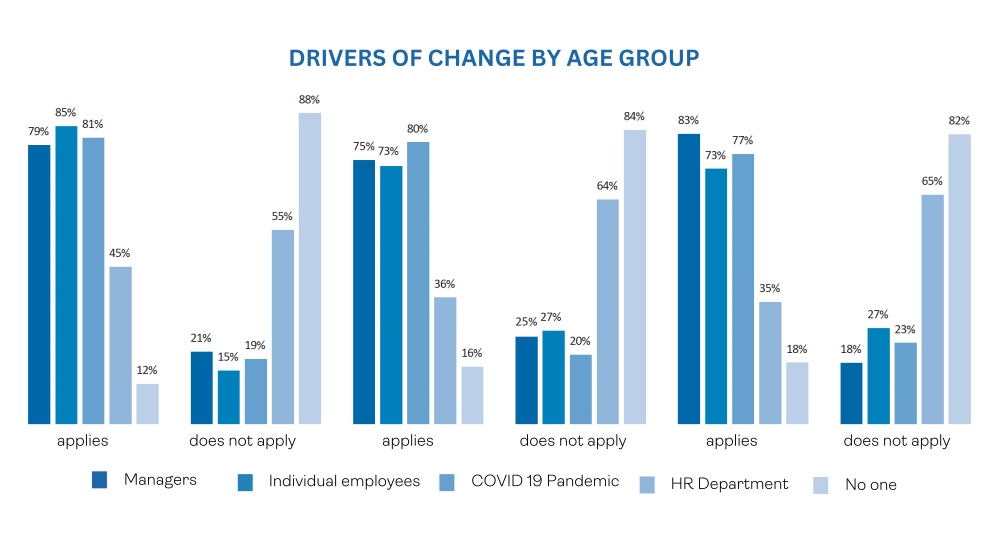
- 80% attribute the change to leadership
- 74% say employees actively drive the transformation
- 78% believe the pandemic accelerated these changes
Who or what provides the impetus for a change in work culture was also surveyed. Who in the company is pushing for the redesign of work? Unsurprisingly, the survey shows that there is no "one" driving force for New Work, but that managers in 80% and employees in 74% of the cases have a share in the innovation based on division of labour. And with a 78% approval rate, the assumption that the Corona pandemic has set the pace is also confirmed. Without Corona, the progress made by companies towards a new world of work would have been considerably less. Surprisingly, the HR department ranks somewhat lower, with only 36% of the organisations surveyed attributing an active role to it in connection with the change in the world of work.
Generational perspectives also differ:
- Professionals under 30 see employees themselves as the main drivers
- Respondents over 40 see leadership as the primary force
Who or what provides the impetus for a change in work culture was also surveyed. Who in the company is pushing for the redesign of work? Unsurprisingly, the survey shows that there is no "one" driving force for New Work, but that managers in 80% and employees in 74% of the cases have a share in the innovation based on division of labour.
And with a 78% approval rate, the assumption that the Corona pandemic has set the pace is also confirmed. Without Corona, the progress made by companies towards a new world of work would have been considerably less. Surprisingly, the HR department ranks somewhat lower, with only 36% of the organisations surveyed attributing an active role to it in connection with the change in the world of work.
The assessment of who is responsible for a new work culture differs from the point of view of the individual age groups: the under-30s see individual employees as the lead (85%), while the over-40s attribute the greatest influence to managers (83%). This may also be due to the fact that the proportion of managers in the over-40s group is higher than among the under-30s.
Working Conditions and Workload in Finance
Finance professionals generally evaluate their personal working situation positively.
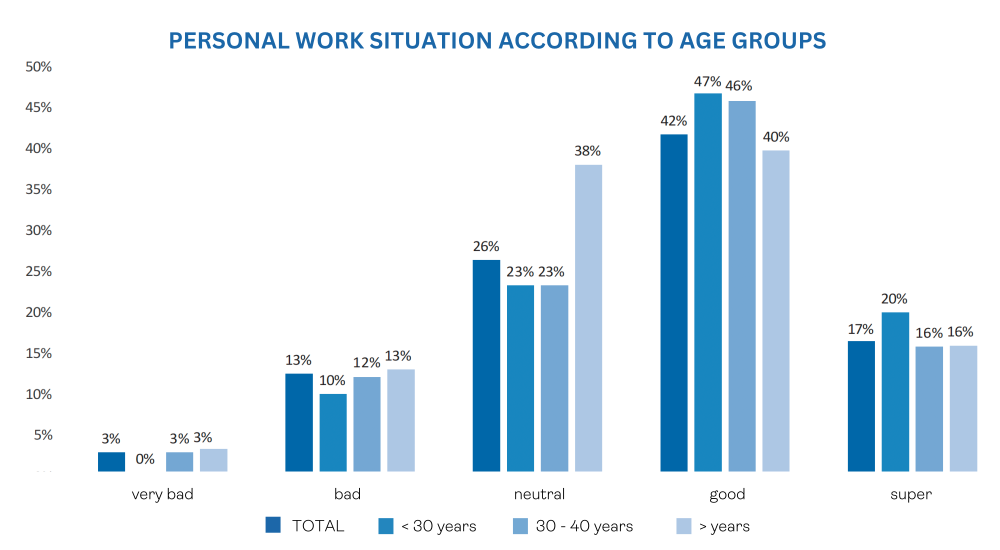
- 59% describe their work situation as positive or very positive
- 16% report negative experiences
- 26% remain neutral
The majority of managers and professionals rate their personal work situation as good to very good. This is mainly due to working conditions such as a pleasant working atmosphere, a safe and technologically well-equipped workplace, a good work-life balance and attractive salaries, which are offered by the majority of companies. The workload is mostly unchanged compared to the previous year, which can also be attributed to the advantages of remote work and more flexible working arrangements.
Key factors contributing to positive perceptions include:
- modern technology
- strong workplace culture
- attractive salaries
- good work-life balance
- secure employment conditions
How do the respondents assess their personal work situation as a general summary of the work-related circumstances and conditions? The majority of respondents assess their own work situation as positive or very positive (59%). Only 16% of the respondents consider their work situation to be bad or very bad. 26% are indifferent and cannot or do not want to commit themselves.
Here, too, the under-30s are more positive about individual criteria than the other age groups. The majority of the over 40s assess their personal work situation as good to excellent, while this is the case to a lesser extent (56%). It is therefore not surprising that it is the over 40s who, at 38%, are much more likely than the other respondents not to want to make a personal commitment and thus also latently express their dissatisfaction.
The assessment of the personal work situation is also overlaid by the workload. This study examines the extent to which the workload of the respondents has changed positively or negatively in the last two years, but does not make any statement about the absolute workload. It is interesting to note that for a significant proportion of respondents, the workload has remained unchanged compared to COVID times (48%). 17% of the participants state that their workload has improved as a result of the pan- demy, whereas 36% indicate that their workload has worsened. For a majority of 83% of all respondents, COVID does not mean any relief. At the same time, however, this does not affect satisfaction with their own work situation, which suggests that the respondents have learned to deal with workload.
In terms of age groups, there is one result that stands out: 67% of those under 30 see an improvement in their workload. Among older respondents, the figures are significantly lower (19% among 30 to 40 year-olds and 16% among those aged > 40). At the same time, only 10% of those under 30 see a worsening of the workload.
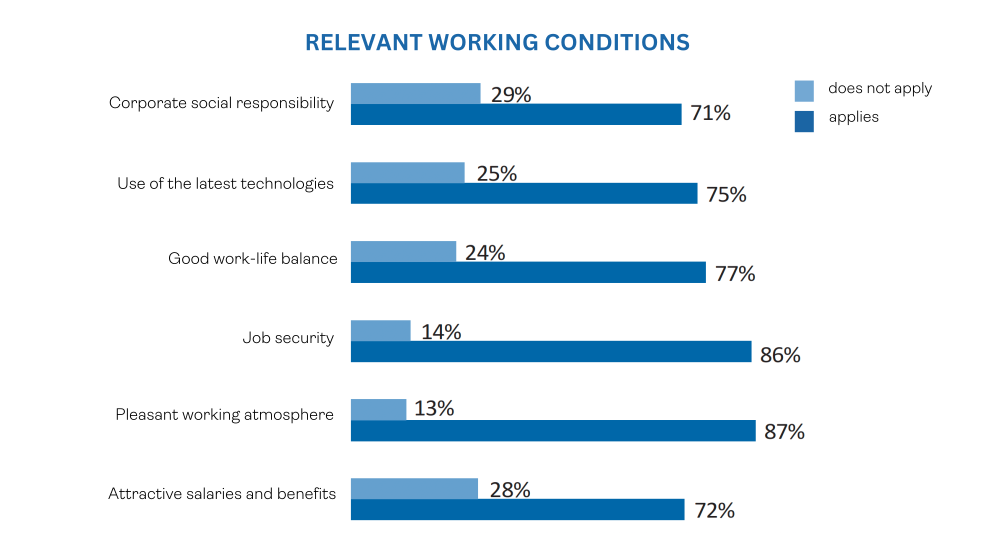
One can certainly conclude from this that especially the "Next Generation" has benefited from the new working environment in the home office and that the stress, if any, is primarily observed among the core performers (30 to 40 years, >40 years). After the majority of the interviewees had positive about their personal work situation, it is not surprising that the decisive factors are also positive. For example, 75% confirm that they have access to the latest technologies - a success factor in the financial sector that should not be underestimated. 77% consider themselves to have a good work-life balance, as many as 86% see their jobs as secure and 87% express a high level of satisfaction with regard to the pleasant working atmosphere. The fact that the companies participating in the survey have a social responsibility also leads to a good mood among 71% of the respondents. And last but not least, it also seems to fit when it comes to remuneration: 72% see themselves well remunerated.
New talent and labour shortages
CFOs are looking for new staff, but are finding it increasingly difficult to do so. The demand for CFO staff continues to rise as the tasks in finance become more diverse and complex. Despite the ongoing pandemic, employers want to invest more in staff and create new positions. In doing so, they are encountering a labour market situation in which the search for skilled personnel and the increasing struggle for highly qualified talent represent major challenges. This also increases the competitive pressure between companies. It is to be expected that the shortage of skilled workers will become even more acute when the number of infections decreases and the contact restrictions are removed.
In the short term - one to six months - the majority of respondents (59%) do not see any changes in the FTEs coming to the companies. Just under a third plan to hire new employees. Around one tenth expect departments to shrink. In the medium to long term (in the next one and a half to three years), capacities in the finance departments are to be further expanded. In the next one and a half years, almost 40% expect an expansion of personnel resources and 84% still assume that no personnel will be reduced. In the next three years, as many as 47% expect additional staff to be hired in their area. The further into the future it goes, the more optimistic the assessments become. In any case, this trend refutes the idea that digitalisation will eat up jobs. Digitisation simplifies many things, but at the same time it demands higher qualifications.
In view of these expansion plans and new requirements, the shortage of skilled workers poses a considerable risk for the CFO areas. Almost two-thirds of the companies surveyed already have problems finding suitable competence bearers. In addition, about one third only accept inoculated persons. Do new employees bring the necessary skills with them once they start in the company? At first glance, the answer is positive: In at least 73% of the cases, the newly hired employees have the required competences. At the same time, this is hardly or not at all the case in about 30% of companies, which can be very detrimental to the existing team. Tasks are not completed, are completed inadequately or incorrectly, knowledge is lost, competences are not expanded but rather reduced.
Conclusion - The mood in the financial sector is good, value is rising
The managers and professionals in the finance sector are generally positive about their work in their own company, the mood is good and seems to have withstood the difficult conditions of the last two pandemic years. The working conditions and the extent to which companies have already managed to establish a modern working culture are decisive for this. The planned expansion of the workforce underlines the growth course of the finance function, its increasing value and the development opportunities it offers, if it were not for the impending shortage of skilled workers. A labour market situation in which the search for skilled personnel and the increasing struggle for highly qualified talents represent the greatest challenge can significantly slow down the further development of the CFO organisation. Strategic personnel planning, intelligent competence management and, last but not least, CFOs who know how to match talent and competences to the right jobs are therefore required.

Collaboration:
Dr Rita Niedermayr (Managing Director of the Controller Institute and Partner at EY Austria) & Matthias Schulmeister managing partner of Schulmeister Management Consulting Group)
Workload and Working Conditions Across Age Groups
Workload Trends Among Finance Professionals
The survey also reveals interesting differences across age groups among finance professionals and managers. 67% of respondents under the age of 30 rate their personal work situation as good to very good, while this is the case to a lesser extent among respondents over the age of 40 (56%). It is therefore not surprising that professionals over 40 are more likely to remain undecided, with 38% choosing not to clearly evaluate their personal work situation, which may indirectly reflect a certain level of dissatisfaction.
The perception of one’s personal work situation in finance departments is also strongly influenced by workload. The study examines how the workload of finance professionals has changed over the past two years – whether positively or negatively – but it does not assess the absolute workload level.
Interestingly, for a significant share of respondents (48%), workload has remained unchanged compared to the pandemic period.
While 17% of participants report that their workload improved during the pandemic, 36% indicate that their workload has worsened. For 83% of respondents, the pandemic therefore did not result in a reduction in workload. At the same time, this does not appear to have significantly affected overall job satisfaction among finance professionals, suggesting that many respondents have learned to adapt to higher workload levels.
When looking at the results by age group, one particularly striking finding emerges: 67% of respondents under the age of 30 report an improvement in their workload compared to the period before COVID-19. Among older professionals, the figures are significantly lower (19% among those aged 30–40 and 16% among those over 40). At the same time, only 10% of respondents under 30 report a worsening workload.
These results suggest that the next generation of finance professionals has benefited particularly from modern working models such as remote work and home office arrangements. Increased workload, where it occurs, appears to be concentrated primarily among experienced professionals and core performers in finance roles aged 30 and above.
Positive Working Conditions in Finance Departments
Since the majority of respondents rate their personal work situation in finance roles positively, it is not surprising that the underlying working conditions are also viewed favorably. Several key factors contribute to the positive perception of the work environment in finance departments.
For example, 75% of respondents report having access to modern technologies, which is a crucial success factor in today’s digital finance environment. Modern tools and systems are increasingly essential for efficient processes in accounting, controlling and financial management.
In addition, 77% of finance professionals report a healthy work-life balance, while 86% consider their jobs secure. Workplace culture also plays an important role: 87% express high satisfaction with the working atmosphere within their organization.
Another factor that positively influences employee satisfaction is corporate social responsibility. Around 71% of respondents state that working for a company that takes social responsibility seriously contributes to a positive workplace environment.
Finally, compensation also appears to be competitive: 72% of respondents believe they are well remunerated for their work in finance roles.
As in previous results, younger professionals under the age of 30 tend to evaluate several of these factors more positively than older age groups, indicating that the next generation of finance professionals may benefit particularly from modern working conditions and workplace culture.
Talent Shortage in Finance: CFOs Struggle to Find Qualified Professionals
CFOs are increasingly looking for new employees – but finding qualified candidates is becoming more difficult. The demand for professionals in the CFO organization continues to rise as the responsibilities within finance departments, accounting and controlling become more diverse and complex.
Despite the ongoing pandemic, many employers are planning to invest in personnel and create new finance positions. However, companies are facing a challenging labor market in which the search for skilled finance professionals and the growing competition for highly qualified talent represent major obstacles. As a result, competition between companies for qualified finance specialists is intensifying.
It is therefore likely that the talent shortage in the finance sector in Austria will become even more pronounced once pandemic-related restrictions are lifted and economic activity fully resumes.
Hiring Plans in Finance Departments
In the short term – within the next one to six months – the majority of respondents (59%) expect no major changes in headcount (FTEs) within their organizations. However, nearly one third of companies plan to hire additional finance professionals, while roughly 10% anticipate shrinking departments.
Looking at the medium to long term, the outlook becomes significantly more optimistic. Many organizations expect their finance teams to expand further.
- Almost 40% expect an increase in finance staff within the next 18 months
- 84% believe no job reductions will take place
- 47% expect additional hiring in finance departments within the next three years
The further companies look into the future, the more optimistic their expectations become.
These results clearly challenge the assumption that digitalization will eliminate finance jobs. While digital transformation simplifies many processes, it simultaneously increases the demand for highly qualified finance professionals with advanced skills.
Talent Shortage as a Key Risk for Finance Departments
Given these planned expansions and the increasing complexity of finance roles, the shortage of skilled professionals represents a major risk for CFO organizations.
Nearly two thirds of surveyed companies already report difficulties in finding suitable candidates for finance positions. In addition, about one third of organizations state that they only hire vaccinated candidates, which further reduces the available talent pool.
But even when companies successfully recruit new employees, another challenge emerges: Do new hires possess the necessary skills and competencies?
At first glance, the outlook appears positive. In at least 73% of cases, newly hired employees bring the required competencies for their roles in finance departments.
However, in around 30% of companies this is only partially or not at all the case. This can create significant challenges for existing teams: tasks may be performed incorrectly or incompletely, valuable knowledge can be lost, and overall competencies within the organization may stagnate or even decline.
Strategic Succession Planning in Finance: Find the Right Talent
Whether you are looking to strengthen your finance team or plan a leadership succession, finding the right professionals is crucial.
As Austria’s leading recruitment consultancy for finance professionals, we support companies in identifying and attracting qualified specialists – from controllers to CFOs.
Finance Functions Are Growing in Importance in Austria
Finance Functions Are Growing in Importance in Austria
Finance professionals and managers generally view their work within their organizations positively. Overall morale remains strong and appears to have remained stable despite the challenging conditions of the past two pandemic years. A key reason for this is the quality of working conditions in finance departments and the extent to which companies have already succeeded in establishing modern workplace cultures and contemporary working models.
The planned expansion of finance teams further highlights the growing importance of the finance function within organizations. It also reflects the increasing strategic relevance of finance roles and the attractive career opportunities emerging in areas such as accounting, controlling and financial management — were it not for the growing shortage of qualified finance professionals.
However, a labor market characterized by a shortage of skilled professionals and intense competition for highly qualified finance talent can significantly slow down the further development of CFO organizations. To address these challenges, companies need strategic workforce planning, effective skills and competency management, and leadership teams that recognize the true value of talent.
Ultimately, CFOs and finance leaders must ensure that skills, expertise and talent development receive the strategic priority they deserve within their organizations.
Key Takeaways from the Finance Workforce Study
- Finance professionals remain largely satisfied with their work environment, despite the challenging conditions during the pandemic years.
- Modern working conditions, remote work and improved workplace culture have contributed significantly to positive job satisfaction in finance departments.
- The strategic importance of the finance function continues to grow, as organizations increasingly rely on finance teams for decision support and business insights.
- At the same time, companies are planning to expand their finance teams in the coming years, reflecting the increasing complexity of finance roles.
- However, the shortage of qualified finance professionals represents one of the biggest risks for CFO organizations and could slow down further growth if companies fail to attract and retain talent.

FAQ: New Work and the Future of Finance Jobs
What is New Work in finance?
New Work in finance refers to modern working models such as remote work, agile collaboration, flexible working hours and a stronger focus on employee autonomy and workplace culture within finance departments.
How is the CFO organization changing?
The CFO organization is evolving from a traditional accounting and reporting function into a strategic business partner. Modern finance teams are increasingly involved in data analysis, strategic planning and digital transformation.
Is there a talent shortage in finance in Austria?
Yes. Many companies report increasing difficulties in finding qualified professionals in finance, controlling and accounting. The demand for skilled finance talent continues to grow as finance departments take on more strategic responsibilities.
How has remote work affected finance professionals?
Remote work has increased flexibility for finance professionals and improved work-life balance in many organizations. However, it has also created new challenges in communication, leadership and workload management.
Are finance jobs declining because of digitalization?
No. Digitalization is changing finance jobs rather than eliminating them. While automation simplifies routine tasks, companies increasingly need highly skilled professionals for analysis, strategy and financial decision support.