




Objective of the Pay Transparency Directive 2026: Equal pay for equal work
The goal is clear: equal pay for equal work or work of equal value. According to KPMG, the gender pay gap in Austria is around 19%, which is significantly higher than the EU average of 13%. This is where the new directive comes in: With more transparency, unfair pay is to be uncovered and eliminated. And this doesn't just affect large corporations.
Binding transparency measures are intended to uncover and eliminate discrimination. The aim is to achieve fairer, non-discriminatory pay across all sectors (source: Council of the European Union).
What does the EU Pay Transparency Directive mean for you in concrete terms?
The EU obliges companies to take the following measures, among others (source: Stepstone):
- Salary information in job advertisements
As an employer in Austria, you are already obliged to state the minimum salary or salary range in your job advertisements - including a reference to the applicable collective agreement. Job titles must also be formulated in a gender-neutral way. According to the new Remuneration Transparency Directive, in future you will no longer be allowed to ask applicants about their current salary or salaries from previous employment relationships. - Right to information for employees
In future, your employees will have the right to receive information about the average pay of colleagues in comparable positions and with comparable qualifications. As an employer, you are obliged to disclose the criteria for determining pay. - Regular reporting obligations
Companies with 100 or more employees must regularly prepare internal reports on the gender pay gap. These include data on basic salaries and variable remuneration components. - Reversal of the burden of proof & compensation
In the event of suspected discrimination, the company will in future have to prove that there is no unequal treatment. Violations may result in compensation payments.
In the overview below, you will find a compact presentation of the most important obligations arising from the EU Pay Transparency Directive - categorised according to company size. It shows, depending on the size of the company, when which information obligations apply. This allows you to keep track of which requirements apply to your company.
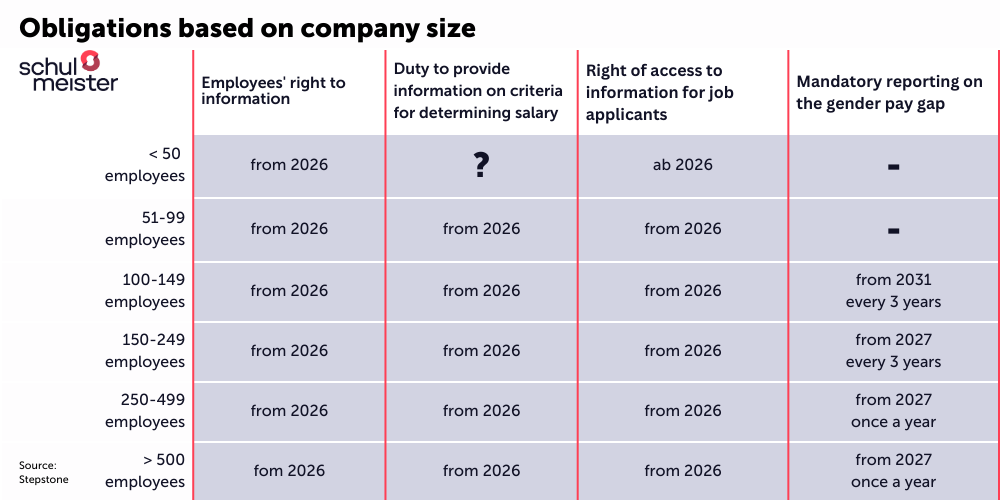
How does the Pay Transparency Directive affect Austrian employers?
Although there are already regulations such as the disclosure of minimum salaries in job advertisements or income reports, the new directive will significantly tighten your obligations (source: Deloitte).
In particular, you should expect the following (sources: StepStone, Deloitte):
- Customisation of job advertisements: Make sure all job postings include required salary information and are worded in a gender-neutral way.
- Establish information mechanisms: Implement internal processes that enable employees to exercise their rights to information
- Preparation of pay reports: Companies with more than 100 employees must prepare and publish regular reports on the pay gap.
- Review and adjust remuneration structures: Analyse the current remuneration structures in your company to ensure that they are gender-neutral and non-discriminatory.
There is still no final draft legislation for implementation in Austria. The Ministry of Social Affairs is currently working on it. However, one thing is clear: implementation will be mandatory.
5 practical tips for implementing the EU Pay Transparency Directive
To ensure that you are well prepared as an HR manager company, you should consider the following steps:
1. Analysing the existing structure
- How is the current remuneration system structured?
- What criteria determine salary levels (e.g. qualifications, experience, responsibility)?
- To what extent does the collective agreement serve as a basis?
- Are there gender-specific differences that need to be explained or eliminated?
2. Record and categorise equivalent activities in the company
- Is there a clear system for categorising roles, functions and areas of responsibility?
- Are activities with comparable responsibility, qualifications or complexity grouped together?
- How does the company define what is considered "equal" or "equivalent"?
- Is there a basis (e.g. function matrix, job grading system) that ensures comparability?
3. Prepare for information & reporting obligations
- Establishment of a system for the regular collection of pay data by gender.
- Automated reporting (e.g. via HR software) to create legally compliant reports.
- Define clear responsibilities in the HR team (data analysis, communication, legal matters).
4. Detailed documentation
- Especially for new hires: Why was which salary awarded?
- Introduce standardised protocols for salary negotiations.
- Document transparent criteria for bonuses, promotions and special payments.
5. Strengthen internal information flow
- Sensitise and train managers: What does fair remuneration mean in practice?
- Clear communication of the company's position on equal pay.
- Establishment of a trustworthy feedback system for employees.
Opportunities for companies: Improve your employer branding
In addition to the regulatory requirements, the directive also offers opportunities. Especially with regard to your employer branding strategy:
- Increasing employer attractiveness: Through transparency and equality, you position yourself positively in the competition for talent - especially with Generation Z, who attach great importance to fairness.
- Improving the corporate culture: A transparent and fair approach to remuneration issues can increase employee satisfaction and loyalty.
- Promoting diversity: By paying fairly, you encourage diverse perspectives, which in turn can lead to more innovative and successful teams.
With these measures, you are sending a clear signal in favour of diversity, equality and a modern corporate culture.
Conclusion: The time to act is now!
The EU Pay Transparency Directive is not just a bureaucratic monster - it is a wake-up call. For companies in Austria, it means additional work, but also the opportunity to create a modern, fair and attractive working environment.
HR managers should start now to review their salary structures, set up processes and actively practise transparency. Those who wait run the risk of not only missing out on legal deadlines - but also missing the boat in the competition for the best talent.