Quick Answer: What Does Upskilling Mean?
Upskilling means the targeted development of existing employees so they can take on new technologies, tasks or roles.
In IT, upskilling typically includes skills in areas such as:
- Artificial Intelligence (AI)
- Cloud Services
- Cyber Security
- Data Engineering
- DevOps
- SAP S/4HANA
- Data Analytics
Upskilling helps companies retain existing knowledge, strengthen employee loyalty and respond more quickly to technological change.
Why Upskilling Is More Important Than Ever
Only a few years ago, many companies focused almost exclusively on recruiting. Today, qualified IT specialists remain scarce, while new technologies are continuously reshaping existing roles and responsibilities.
This development is also reflected in current recruiting trends, where skills, technology and targeted candidate approaches are becoming increasingly important.
The World Economic's Future of Jobs Report 2025 shows that:
- around 39% of today’s core skills are expected to change by 2030
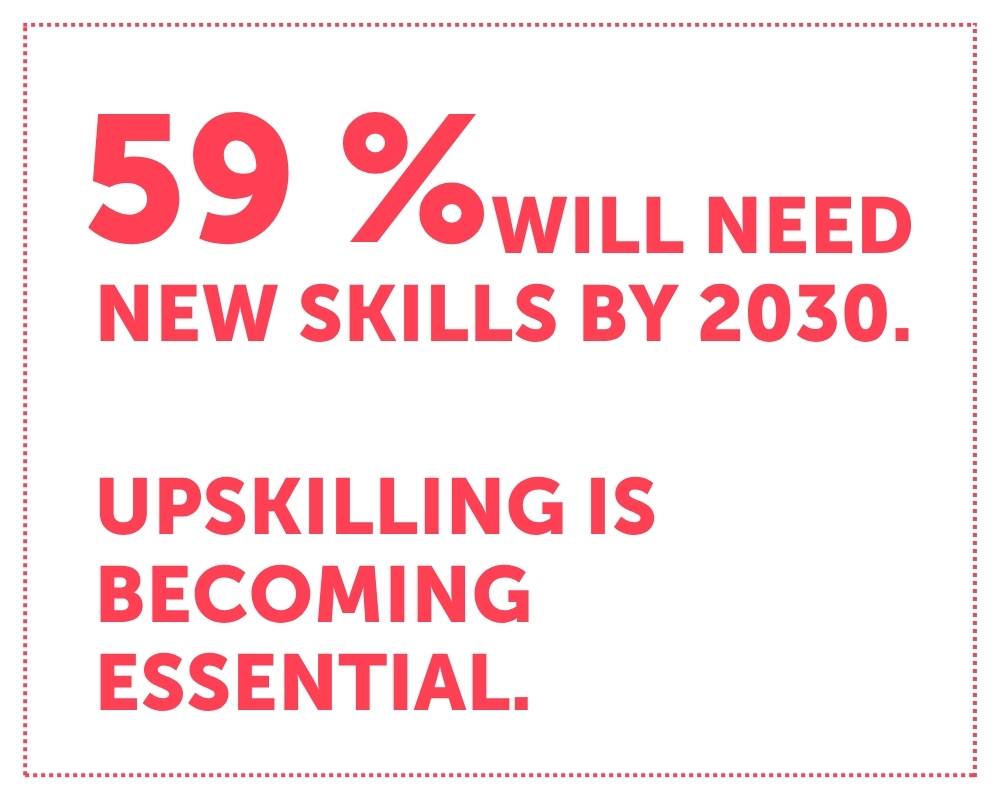
- around 59% of workers will need training or reskilling by 2030
- technological skills are among the fastest-growing skill areas worldwide
Demand for qualified IT specialists also remains high in Austria. According to the European Commission, digital skills gaps continue to affect companies across Europe. Small and medium-sized enterprises in particular face the challenge of attracting and retaining specialized IT talent.
For companies, this means one thing: not every skill can be permanently bought on the external labor market. Many capabilities need to be built within the organization. Employees must continuously acquire new knowledge and adapt to new technologies.
“In the past, companies hired skills. Today, they increasingly hire the ability to acquire new skills.”
Johann Halmdienst, Partner at Schulmeister, Head of IT & Technology
The ability to learn continuously is becoming just as important as existing specialist knowledge. Technologies, programming languages, cloud platforms and AI applications are developing so quickly that traditional training cycles are often no longer sufficient.
Companies should therefore not only look for existing skills, but also for learning agility, technical curiosity and the willingness to continuously develop.
Artificial Intelligence Is Changing Roles Faster Than Job Titles
Artificial intelligence does not automatically replace entire professions. Instead, it changes the tasks within existing roles — for example in IT, finance and accounting departments. The Microsoft Work Trend Index 2025 shows that companies are increasingly looking for employees who can work productively with AI.
In the future, demand will focus less on individual tools and more on capabilities such as:
- critical thinking
- data literacy
- developing AI agents for business impact, including prompt engineering
- process understanding
- human-AI collaboration
This is creating new skill profiles in IT departments. Companies need employees who understand both technology and business processes — and who can translate new tools into real business value.
Recruiting or Upskilling? Finding the Right Balance
The key question is no longer: recruiting or upskilling?
The better question is: which skills should we develop internally, and which skills do we need to bring in from outside in the short term?
This question is also an important part of long-term succession planning and strategic workforce planning.
The most successful companies combine both approaches.
Upskilling | Recruiting |
| Develops existing employees | Brings new skills into the company |
| Strengthens employee retention | Closes short-term skill gaps |
| Preserves company knowledge | Provides access to specialist expertise |
| Preserves company knowledge | Creates short-term capacity |
Targeted employee development is not only a response to skill gaps. It is also an important lever for improving employee retention. Employees who see development opportunities within the company are more likely to stay, grow and contribute to future business success.
Which IT Skills Are Currently in High Demand?
Current studies by the World Economic Forum, Microsoft and LinkedIn show that several technology areas are growing particularly fast.
Artificial Intelligence
Generative AI is changing software development, testing, automation and business processes. Companies increasingly need employees who can use AI tools effectively and responsibly.
Data Engineering
Data is the foundation of every AI application. Data Engineers are therefore among the most in-demand IT professionals, especially in companies that want to use data more strategically.
Cyber Security
As digitalization increases, so do the requirements for information security. Cyber Security remains one of the fastest-growing skill areas.
Cloud Services
Cloud platforms such as Microsoft Azure, AWS and Google Cloud have become standard components of modern IT environments. Cloud expertise is therefore essential for many transformation projects.
DevOps and Automation
Automated development, testing and deployment processes are becoming increasingly important for companies that want to improve speed, quality and scalability.
SAP S/4HANA
Many companies are currently in the middle of SAP transformation projects. SAP Consultants with S/4HANA experience remain highly sought after in Austria and across Europe.
The decisive factor is not only the ability to use individual tools. For companies, it is becoming increasingly important how quickly IT specialists can adapt to new technologies, systems and processes.
Where Upskilling Reaches Its Limits
As important as internal training is, not every skill can be developed quickly within an organization.
External recruiting is often the better solution when companies need highly specialized expertise, short-term capacity or leadership experience that does not yet exist internally.
This is especially true for roles such as:
- AI Engineers
- Cloud Architects
- SAP S/4HANA Consultants
- IT Security Experts
- Enterprise Architects
- IT leadership roles
For time-critical projects, IT Interim Management can also be a useful alternative. It allows companies to access experienced specialists or leaders for a limited period of time without committing to a permanent hire.
Why Modern IT Recruitment Consultancy Is More Than Recruiting
A modern IT recruitment consultancy does more than place qualified IT specialists. It helps companies understand which skills they need today — and which skills they will need tomorrow.
This includes supporting companies in:
- identifying future skill requirements
- recognizing and closing skill gaps
- combining recruiting and upskilling strategies
- approaching hard-to-reach IT specialists
- strengthening long-term workforce planning
Our experience shows that the most successful companies develop their existing teams consistently and complement them with external specialists where needed.
Conclusion: Upskilling and Recruiting Belong Together
Upskilling is not a replacement for recruiting. Recruiting is not a permanent solution for every skill gap.
Companies that intelligently combine both strategies can react faster to technological change, strengthen their employer attractiveness and build future-ready IT teams.
“Companies should invest in people who are willing and able to learn something new tomorrow and adapt quickly. Successful IT teams are created where targeted upskilling and the recruitment of specialized experts go hand in hand.”
Johann Halmdienst, Partner for Technology & IT

FAQ: Upskilling in IT
Upskilling in IT means developing existing employees so they can take on new technologies, tools, tasks or roles. Examples include training in artificial intelligence, cloud services, cyber security, data engineering, DevOps or SAP S/4HANA.
Upskilling means expanding an employee’s existing skills so they can perform their current or future role better. Reskilling means training an employee for a significantly different role or career path.
Upskilling is especially useful when employees already have a strong internal knowledge base, understand company processes and show the potential to learn new technologies. It is also valuable when companies want to improve employee retention and build long-term capabilities.
Recruiting is often the better option when companies need highly specialized expertise quickly, for example for AI, cloud architecture, cyber security, SAP S/4HANA or IT leadership roles. It is also useful when there is no internal foundation on which to build the required skill.
Companies in Austria are facing a persistent shortage of qualified IT specialists. Upskilling helps organizations reduce dependency on the external labor market, retain knowledge and prepare existing teams for technological change.
Highly demanded IT skills include artificial intelligence, data engineering, cyber security, cloud services, DevOps, automation, SAP S/4HANA and data analytics.
Successful companies combine upskilling and recruiting because both strategies solve different problems. Upskilling builds long-term internal capabilities, while recruiting provides access to new expertise and closes short-term skill gaps.