

![[Translate to English:] LinkedIn Profil optimieren Jobsuche Tipps Schulmeister Personalberater](/fileadmin/user_upload/Schulmeister_personalberater_linkedin_Profil_optimieren_tipp_Recruiter_Jobsuche.jpg)
Quick Answer: How Do I Optimise My LinkedIn Profile?
A strong LinkedIn profile is much more than a digital version of your CV. Recruiters and recruitment consultants pay particular attention to a clear headline, relevant keywords, up-to-date professional experience, specialist skills and a professional profile photo.
The more complete, current and clearly structured your profile is, the higher the chance that you will be found by recruiters, recruitment consultants, headhunters and companies.
The most important success factors are:
- a professional profile photo,
- a strong headline with relevant keywords,
- a compelling “About” section,
- fully completed professional experience,
- up-to-date skills and certifications,
- recommendations and references,
- regular activity on LinkedIn,
- activated job preferences such as “Open to Work”.
Why Is LinkedIn So Important for Your Job Search?
In short: LinkedIn is now one of the most important platforms for professional networking, recruiting and active sourcing. Many companies actively search for suitable candidates on LinkedIn and fill positions before they are publicly advertised.
In the past, a job search often started with an application to an advertised position. Today, recruiting also works the other way around: companies, recruiters and recruitment consultants actively search for suitable specialists and executives and approach them directly – for example via LinkedIn.
This is especially common in specialised fields such as finance, accounting, controlling, technology & IT, engineering or real estate. In these areas, active sourcing has become part of everyday recruiting. A professional LinkedIn profile therefore not only increases your visibility, but also improves your chances of being approached for relevant career opportunities.
At the same time, LinkedIn is much more than a job search platform. You can use it to:
- build a professional network,
- make your experience, projects and achievements visible,
- position yourself as an expert in your field (Personal Branding),
- receive relevant job recommendations,
- and stay informed about current developments in your industry.
Specialists and executives in particular benefit from being visible even when they are not actively looking for a new job. Many attractive positions arise through personal recommendations, networks or direct approaches from recruiters and recruitment consultants.
Tip from our recruitment consultants: Do not wait until you actively want to change jobs before updating your LinkedIn profile. A well-maintained profile increases your long-term visibility and ensures that you can also be considered for interesting positions you may not have actively searched for yourself.
What Is Active Sourcing?
Active sourcing refers to the proactive search for qualified candidates by companies, recruiters, recruitment consultants and headhunters. Instead of waiting for incoming applications, they identify suitable specialists and executives themselves and contact them directly.
This search often takes place via professional networks such as LinkedIn and increasingly with the support of AI-powered recruiting and matching tools. These tools can help assess profiles based on professional experience, skills, industry knowledge, keywords or career stages.
Active sourcing is particularly important for specialised positions, for example in finance, IT, engineering or real estate.
For candidates, this means that a well-maintained LinkedIn profile is increasingly becoming a digital career profile. It often creates the first impression for recruiters, recruitment consultants and potential employers – even if you are not actively applying for jobs.
How Do Recruiters Search for Candidates on LinkedIn?
How recruiters are searching for the right candidates on LinkedIn
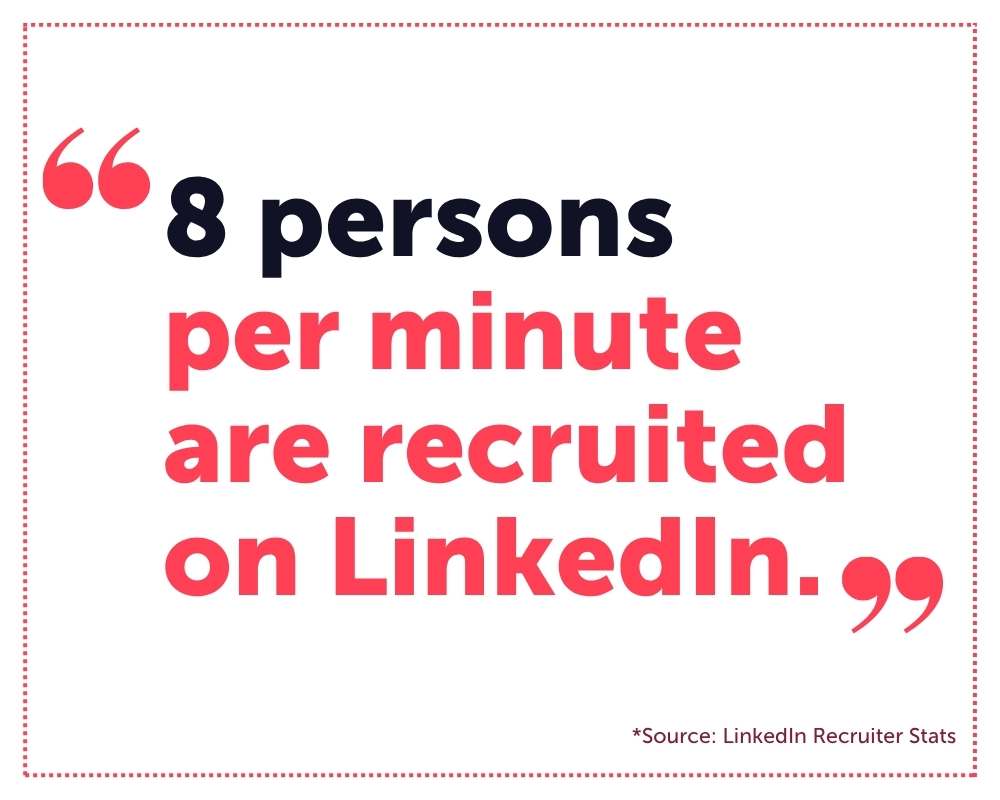
Every minute, six people worldwide are hired on LinkedIn - this number is published by the network itself. So it's time to start thinking about how you too can become part of this statistic in the future!
In short: Recruiters usually do not search LinkedIn by name. They search for relevant qualifications, skills, job titles and keywords.
Professional recruiters, recruitment consultants and headhunters often work with LinkedIn Recruiter or other recruiting tools. These tools allow profiles to be filtered according to different criteria and matched with the requirements of an open position. AI-powered functions can also help identify relevant profiles faster and assess them more effectively.
Key search criteria include:
- job title,
- specialist skills,
- professional experience,
- industry,
- location,
- education,
- language skills,
- certifications,
- career level,
- current or previous employers.
It is crucial that this information actually appears in your LinkedIn profile. For example, if you work as a Senior Controller, you should use this job title instead of a vague description such as “Finance Professional”. The same applies to software skills or technologies such as SAP S/4HANA, Power BI, DATEV, Microsoft Dynamics, Azure or Python.
The more specific your profile is, the easier it is for recruiters, recruitment consultants and modern recruiting systems to understand which roles you may be relevant for.
From the daily practice of our recruitment consultants: At Schulmeister, we rarely search only for general terms such as “Controller”, “Accounting Specialist” or “Software Developer”. In most cases, we combine several search criteria – such as job title, industry, ERP systems, programming languages, leadership experience or location.
A complete profile with the right keywords therefore significantly increases the likelihood of appearing in search results and being contacted for suitable positions.
Why Are Keywords So Important on LinkedIn?
LinkedIn functions in many ways like a search engine. Recruiters enter search terms and receive matching profiles as results. At the same time, AI-powered recruiting tools can analyse structured profile information and compare it with open positions.
That is why important keywords should not only appear in your job title. They should be included in several relevant areas of your profile – such as your headline, “About” section, professional experience, skills and certifications.
Always ask yourself: What would a recruiter search for if they wanted to find exactly my profile?
Helpful keywords include:
- job titles,
- specialist areas,
- software skills,
- technologies,
- certifications,
- industries,
- methods,
- leadership experience,
- language skills.
A good LinkedIn profile is not overloaded with keywords. It is clear, complete and professionally precise. This helps recruiters, recruitment consultants, search engines and recruiting tools quickly understand your experience and skills.
The 12 Most Important Elements of a Successful LinkedIn Profile
A strong LinkedIn profile is not created in just a few minutes. It develops alongside your career and should be updated regularly. Even small improvements can help you appear more often in recruiter searches and create a more professional first impression.
1. Choose a Professional Profile Photo
In short: A professional profile photo builds trust and increases the likelihood that your profile will be viewed.
Your profile photo is often the first thing recruiters and recruitment consultants notice. Profiles with a professional photo appear more trustworthy and approachable than profiles without an image.
It does not have to be an elaborate business photoshoot. What matters most is:
- a recent photo,
- good image quality,
- a friendly facial expression,
- a neutral background,
- business or business-casual clothing that fits your industry.
Avoid holiday photos, group pictures, selfies or heavily edited images.
Our tip: Especially for managers, specialists and executives, a professional profile photo conveys competence, credibility and approachability.
2. Use Your Header Image as a Personal Business Card
Many LinkedIn users leave the default background image unchanged. However, the header image offers valuable space to underline your professional positioning.
Depending on your role, the following elements can be useful:
- your industry,
- a relevant visual theme,
- your area of expertise,
- company colours,
- a subtle claim or slogan.
Self-employed professionals and executives often use the header image to strengthen their personal positioning. Employees can also create a more professional impression with a suitable banner.
3. Optimise Your Headline with Relevant Keywords
In short: Your headline is one of the most important areas of your LinkedIn profile.
Many users only include their current job title, for example:
Controller at Company XY
A more meaningful version would be:
Senior Controller | Business Partnering | Power BI | SAP S/4HANA | Financial Planning & Analysis (FP&A)
Why does this matter? Recruiters often search for exactly these terms. Your headline is therefore one of the most important areas for LinkedIn search.
Ask yourself:
- Which terms would recruiters and headhunters search for?
- Which areas of expertise do you want to highlight?
- Which software tools or technologies do you know?
The more specific your headline is, the easier it is for you to be found.
4. Use the “About” Section to Tell Your Professional Story
The “About” section should not simply repeat your CV. It is much more valuable when it answers the following questions:
- Who are you?
- What is your professional expertise?
- Which topics are you passionate about?
- What experience do you bring?
- What kind of role are you looking for?
Write naturally and clearly. Recruiters and headhunters want to understand which skills you bring, what motivates you and what value you can add to an organisation.
At the same time, this section offers plenty of space for relevant keywords and search terms.
5. Describe Your Professional Experience in Detail
Many LinkedIn profiles only list job titles under professional experience. Instead, use this section to describe your most important responsibilities, projects and achievements.
Particularly helpful information includes:
- projects you managed or contributed to,
- team size,
- leadership responsibility,
- technologies,
- ERP systems,
- industries,
- measurable results.
Instead of simply writing:
Project Manager
you could write more specifically:
Led international SAP S/4HANA implementation projects with up to 40 project members and budget responsibility in the seven-figure range.
This type of information helps recruiters and recruitment consultants assess much more quickly whether your profile fits an open position.
6. Add Relevant Skills and Expertise
In short: Skills are an important search and matching criterion on LinkedIn.
Many recruiters filter specifically for certain skills. The more complete and relevant your skills section is, the easier it is to understand your expertise.
Depending on your profession, relevant skills may include:
Finance
- IFRS
- UGB
- Controlling
- SAP FI/CO
- Power BI
- Consolidation
- Treasury
- FP&A
Technology & IT
- Azure
- AWS
- Python
- Java
- Kubernetes
- Cyber Security
- SAP S/4HANA
It can also be helpful to have your most important skills endorsed by colleagues or business contacts.
7. Use the “Featured” Section
Many LinkedIn users are not fully aware of this function. However, the “Featured” section is ideal for highlighting your most relevant content.
You can use it to showcase:
- successful projects,
- specialist articles,
- interviews,
- presentations,
- certificates,
- published posts,
- relevant media.
This gives recruiters an immediate impression of your professional expertise.
8. Collect Recommendations, Not Just Contacts
Recommendations are often more credible than a simple list of skills. Ask former managers, colleagues, clients or project partners for a short personal recommendation.
Particularly valuable are statements about:
- collaboration,
- professional expertise,
- leadership behaviour,
- project work,
- communication.
Authentic recommendations can significantly strengthen your credibility.
9. Activate the Right Job Preferences
LinkedIn offers several options to signal that you are open to new opportunities. The “Open to Work” function can help recruiters see that you are generally open to new career opportunities.
You can define:
- which roles you are interested in,
- which locations are relevant for you,
- which types of employment you are considering.
If you are currently employed, the setting “visible to recruiters only” may be the better option. This allows you to signal your openness more discreetly.
10. Stay Regularly Active
In short: A good LinkedIn profile is not only about complete information, but also about regular activity.
You do not need to publish posts every day. Often, small but meaningful interactions are enough, such as:
- thoughtful comments,
- sharing relevant content,
- reacting to posts,
- occasional specialist posts,
- congratulating others on professional achievements,
- expanding your network.
Comments in particular are often underestimated. They increase your visibility, demonstrate your expertise and can lead more people to visit your profile.
Tip from our recruitment consultants: Quality is more important than quantity. You do not have to post every day. If you regularly engage with relevant content and maintain your network, you remain visible to recruiters and recruitment consultants in the long term.
11. Customise Your LinkedIn URL
Many LinkedIn profiles contain automatically generated URLs with numbers and special characters. A customised profile URL looks more professional and is easier to use in application documents, email signatures or on business cards.
Instead of a long standard URL, use a short and clear version with your name, for example:
linkedin.com/in/firstname-lastname
This is a small step, but it creates a much more professional impression – especially when recruiters or recruitment consultants access your profile via application documents, Google or other search systems.
12. Add Contact Information and Relevant Links
LinkedIn allows you to add additional contact information and links. Use this function strategically if it fits your professional profile.
Useful links may include:
- email address,
- personal website,
- portfolio,
- GitHub profile,
- publications,
- project pages,
- company website.
Especially in IT, engineering, marketing, consulting or self-employment, such links can make your professional experience more tangible. Make sure, however, that you only link to professional and up-to-date information.
Checklist: Is Your LinkedIn Profile Complete?
Before you start your job search or try to increase your visibility for recruiters, check the following:
- Is your profile photo recent, professional and approachable?
- Have you added an individual header image?
- Does your headline include relevant keywords for your role, expertise and skills?
- Is your “About” section clear, personal and search-friendly?
- Is your professional experience complete and described with specific tasks, projects and achievements?
- Have you added relevant skills, tools, technologies and certifications?
- Are your most important contents visible in the “Featured” section?
- Have you collected recommendations from colleagues, managers or clients?
- Have you checked your job preferences and visibility settings?
- Are you regularly active through comments, reactions or your own posts?
- Have you customised your LinkedIn URL?
- Are your contact details and relevant links up to date?
Extra tip: Look at your profile from a recruiter’s perspective: Does it become clear within a few seconds what your professional focus is, what experience you bring and which roles could be relevant for you?
How to Get Found by Recruiters and Headhunters
In short: Recruiters and headhunters do not find candidates by chance. They search specifically for job titles, specialist knowledge, technologies, industries and relevant keywords. The more clearly your LinkedIn profile reflects this information, the higher the chance that you will be contacted for suitable positions.
Many candidates believe that recruiters browse profiles one by one or mainly search for names. In reality, recruiting on LinkedIn is much more structured. Professional recruiters, recruitment consultants and headhunters use search filters, combine different criteria and increasingly work with AI-powered recruiting and matching tools.
These tools can help identify profiles faster, recognise alternative job titles and assess candidates based on skills, professional experience, location or industry knowledge. However, the final assessment remains a human task. Whether a person truly fits the role, the company and the corporate culture is still decided by experienced recruiters and recruitment consultants.
For your LinkedIn profile, this means: it should not only be complete, but also clear, precise and search-friendly. Use the terms that recruiters would actually search for – such as specific job titles, areas of expertise, tools, systems, certifications and industries.
Should You Contact Recruiters on LinkedIn Yourself?
Yes, absolutely. Many candidates wait to be found. However, there is nothing wrong with actively contacting suitable recruiters, recruitment consultants or headhunters on LinkedIn.
It is important that your message is short, friendly and specific. A general contact request without context often feels impersonal. A brief personal message is much more effective if it clearly explains who you are and in which area you would like to develop professionally.
For example:
Dear Ms Smith,
I have been working in controlling for several years and am open to exploring new professional opportunities in the medium term. As you specialise in finance positions, I would be pleased to connect with you.
This appears professional and can open the door to valuable conversations – even if there is no specific role available for you at that moment.
How Do You Find the Right Headhunters on LinkedIn?
Not every recruitment consultancy specialises in the same positions. It is therefore worth looking specifically for recruiters, recruitment consultants and headhunters who have experience in your industry or field of expertise.
Pay attention to factors such as:
- specialisation,
- industry knowledge,
- regional experience,
- size and quality of the network,
- published content,
- recommendations,
- relevant contacts,
- experience with similar positions.
Especially for specialised professional and executive roles, it can be helpful to connect with recruitment consultants who truly understand your market. A good recruitment consultancy does not only understand your CV, but also the requirements of companies, salary levels, career paths and current developments in your field.
Our tip: Do not connect randomly with as many people as possible. A targeted network of recruiters, recruitment consultants, industry experts and relevant professional contacts is much more valuable. This helps you increase your long-term visibility for suitable career opportunities.

No-Gos on LinkedIn: 3 Mistakes You Should Avoid
Even small mistakes can cause recruiters and recruitment consultants to overlook your LinkedIn profile or form a less professional impression. Pay particular attention to the following points:
1. Content That Is Too Private or Unprofessional
LinkedIn is a professional network. Content that appears too private, polarising or unprofessional can harm your professional image. Pay attention to which posts, comments and images are publicly visible.
Personality is welcome on LinkedIn – but it should fit your professional profile and support your positioning.
2. Random Connection Requests and Irrelevant Posts
A large network can be helpful, but quality is more important than quantity. Do not send random connection requests to people with whom you have no professional connection. A short personal message increases the chance that your request will be accepted.
The same applies to your own posts: do not post simply for the sake of posting. If you do not have a relevant update, professional insight or helpful perspective to share, a thoughtful comment is often more valuable than a random post. Nobody likes spam – not even on LinkedIn.
3. Vague Information and Unclear Wording
Recruiters value transparency, clarity and consistency. Vague job titles, missing time periods, generic descriptions or contradictory information can make your profile less convincing.
Describe clearly which positions you have held, which responsibilities you had and which areas of expertise you bring. The more precise your profile is, the easier it is for recruiters to assess whether you could be a good fit for an open role.
You can find out more about possible pitfalls in social networks in our article: How Social Media Can Affect Your Career.
Our View from Recruitment Practice
“A good LinkedIn profile is not about impressing everyone – it is about being found by the right people. Candidates who clearly describe their professional focus, achievements and skills increase their chances of being approached by the right companies. In recruiting, it is often not the loudest profiles that stand out, but the most complete and authentic ones.”
– Doris Eichelberger, Recruitment Consultant at Schulmeister in Linz
Prepare Your Next Career Step with LinkedIn
We accompany you on your way to becoming every recruiter's darling
Have you optimised your LinkedIn profile and avoided the most common pitfalls? Then you increase your chances of being found by recruiters, recruitment consultants and companies for suitable positions.
If you are open to your next career step or actively looking for a new role, we will be happy to support you personally. As a specialised recruitment consultancy, Schulmeister has been well connected in Austria for 25 years and supports specialists and executives in finance, accounting, controlling, technology & IT, engineering and real estate.
Whether through LinkedIn, our own networks or our current search mandates: together with you, we assess which positions match your experience, goals and future career plans.
Open positions from Schulmeister
FAQ: Optimising Your LinkedIn Profile
A LinkedIn profile is easier for recruiters to find when it is complete, up to date and keyword-optimised. The most important elements are a strong headline, a professional profile photo, a clearly written “About” section, detailed professional experience, relevant skills, tools and certifications. The clearer your profile shows your experience and expertise, the easier it is for recruiters to identify you for suitable positions.
Headhunters usually search LinkedIn by job titles, skills, industries, locations and areas of expertise. Use specific terms that match your profile, such as “Senior Controller”, “SAP S/4HANA”, “Power BI”, “Accounting”, “Cyber Security” or “Project Management”. Also keep your job preferences up to date and make sure your profile clearly reflects your current experience.
Use keywords that recruiters would actually search for. These include job titles, specialist areas, software tools, technologies, methods, certifications, industries and relevant responsibilities. Examples include “Controlling”, “IFRS”, “UGB”, “SAP FI/CO”, “Power BI”, “Azure”, “Python”, “Kubernetes”, “ESG Reporting” or “Team Leadership”. The keywords should always be accurate and naturally integrated into your profile.
Your LinkedIn headline is one of the most visible parts of your profile. It appears directly below your name and is also shown in search results, connection requests and comments. A strong headline should not only mention your current position, but also include relevant specialisations, skills or tools. This helps recruiters quickly understand what you stand for professionally.
The “About” section should briefly explain who you are, what professional experience you bring, which areas you specialise in and what topics interest you professionally. It should not simply repeat your CV. Instead, use it to make your professional positioning clear and include relevant keywords in a natural way.
“Open to Work” can be useful if you are open to new career opportunities. LinkedIn allows you to make this information visible only to recruiters, which can be helpful if you are currently employed and do not want to make your openness public. Before activating it, check which visibility settings best fit your situation.
Common mistakes include vague job titles, missing keywords, an incomplete “About” section, outdated professional experience, missing skills, no professional profile photo and content that is too private or unprofessional. Random connection requests or irrelevant posts can also create a negative impression. A strong LinkedIn profile should be clear, current, authentic and professionally relevant.
Yes. Specialists and executives in particular benefit from being visible even when they are not actively job searching. Many positions are filled through active sourcing, meaning recruiters or recruitment consultants directly approach suitable candidates. A well-maintained LinkedIn profile can therefore help you be considered for career opportunities before you actively apply.
Yes. Modern recruiting and talent intelligence tools can analyse structured profile information such as skills, professional experience, keywords, locations and career stages. This is why it is important to keep your LinkedIn profile clear, complete and up to date. However, AI does not replace recruiters: people still assess whether a candidate truly fits the role, company and culture.
Public LinkedIn profiles can appear in search engines such as Google, depending on your privacy settings. This makes your LinkedIn profile an important part of your digital visibility. A professional, current and search-friendly profile increases the chance of being found beyond LinkedIn itself.
Yes, contacting recruiters on LinkedIn can be useful, especially if they specialise in your industry or field. Keep your message short, friendly and specific. Briefly explain who you are, what area you work in and what kind of professional opportunities you are open to. A personal message is usually much more effective than a generic connection request.